The methodology, the numbers, and the code — checkable.
These are SomniAI LLC's internal validation results, validated against polysomnography. Three papers, three open-source repositories. Don't take the numbers on faith — run the code on your own data.
The validation set
Detection was evaluated against in-lab and ambulatory polysomnography (PSG): 80 paired PSG nights across 40 participants — 10 in-lab PSG and 70 ambulatory PSG nights with a nasal-airflow cannula, smartphone audio captured simultaneously. The ambulatory majority means most of the data is real home environments, not a quiet lab.
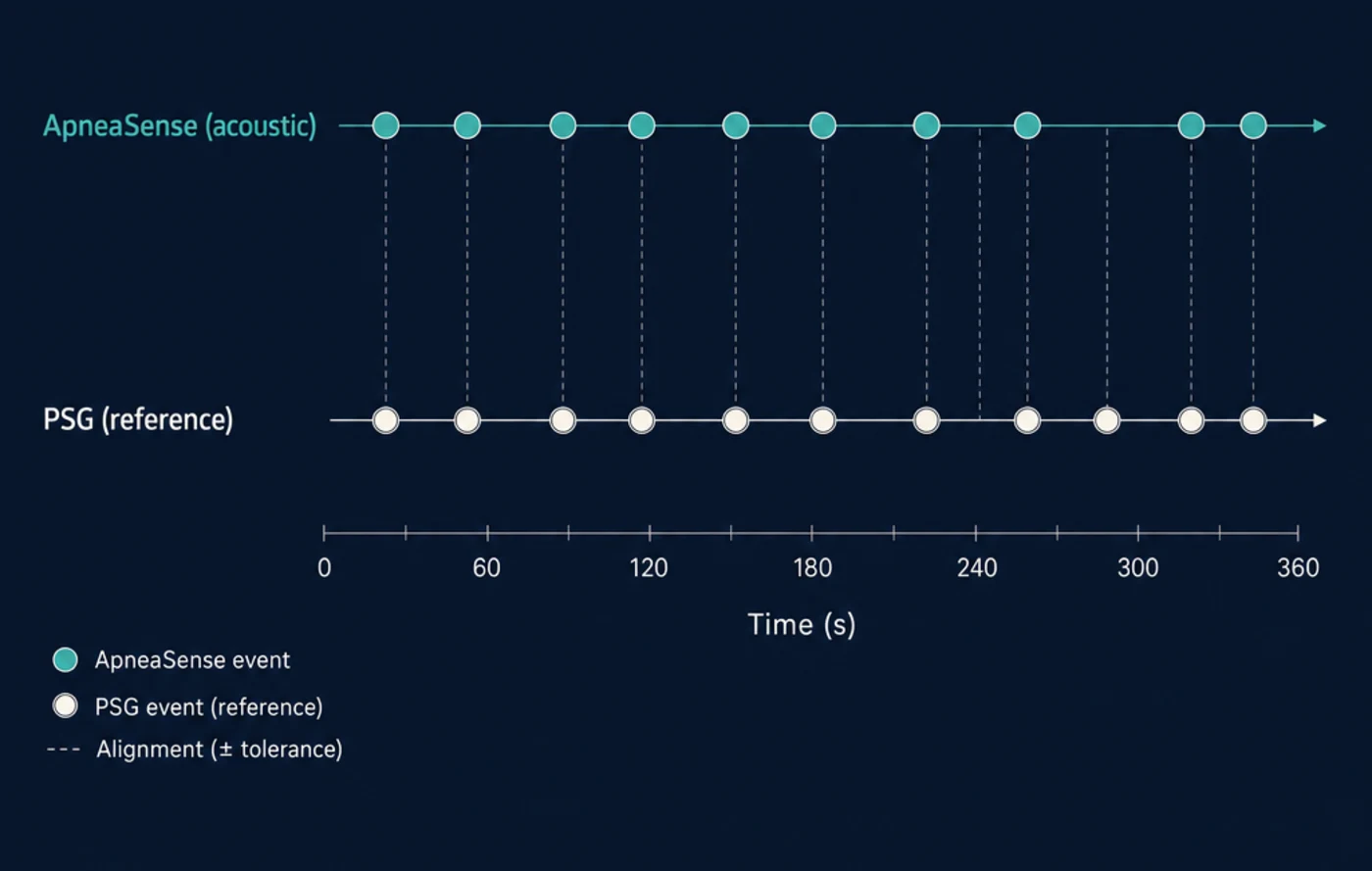
Illustrative A schematic of how acoustic detection is scored against the PSG reference, event by event — not plotted data. The actual agreement is the accuracy numbers above and the per-seed results in the papers and code below.
The complete system — one two-stage cascade
The production model is a complete two-stage on-device audio cascade: Stage-1 snore detection feeds Stage-2 breathing-event detection, with Coordinate-Attention 1D as the Stage-2 method. The whole system is written up as a single paper — a preprint on Research Square with a citable DOI (not peer-reviewed yet, so I'll call it a preprint). Read it — Research Square → · Google Scholar →
How it's built — baseline → attention → production
The same work, broken into the three steps it was built from — a cascade, its attention-based Stage-2 classifier, then that classifier compressed for the device. Each is its own Zenodo preprint with an MIT-licensed code companion.
Step 1 · baseline & cascade
Two CNN baselines + the cascaded two-stage pipeline
The baseline snore and apnea CNNs, with multi-seed bootstrap validation — and the Stage-1→Stage-2 cascade that the next two build on.
Replaces the baseline apnea CNN above as the cascade’s Stage-2 classifier: a 14,001-parameter attention model that keeps temporal position — a 93.2% parameter cut, with accuracy preserved or improved.
Compresses the Stage-2 model above to production size: INT8 quantization-aware training + 50% structured pruning + CoreML. On this dataset, compression raises test accuracy.
The papers and code disclose the full method — the cascaded two-stage architecture over a compact 200×3 @ 1 Hz representation, the Coordinate-Attention 1D formulation, the quantization and pruning protocol, and the evaluation methodology — so the results are reproducible. Certain production specifics — multi-stage gating, event-driven triggering, and the privacy-preserving on-device system architecture — are covered by three co-filed U.S. provisional patent applications (SomniAI LLC) and are not described.
Data availability
The validation corpus — the 80 paired PSG nights and the simultaneous smartphone audio — is not publicly distributed. Participants consented to internal validation, not redistribution, so the raw recordings and labels stay private. What's public is the method and the code: each paper above ships an MIT-licensed companion repository — the algorithm framework and training code, no data — so the methodology is fully reproducible on your own corpus.
Limitations we hold to
Acoustic proxy. We detect sound, not airflow or blood oxygen — PSG and continuous SpO₂ measure the physiological event more directly. We don't claim to beat them.
Screening, not diagnosis. ApneaSense is not a medical device and is not FDA-cleared.
Precision-first. Tuned to avoid false positives, so it under-counts — read the rate as a conservative lower bound.
Sample. Recruited with sleep-breathing complaints; generalization across BMI and healthy cohorts is ongoing.
Citing this work
Authored at SomniAI LLC by the inventor on the pending U.S. patent (PAT-001). Each paper is published on Zenodo with a citable DOI — linked under each paper above; the combined cascade paper is on Research Square. Full profile on Google Scholar and ORCID.